

/…/
—
Venus is the second planet from the Sun and close to Earth in size. Its thick CO₂ air with sulfuric acid clouds traps heat: ~465 °C and pressure ~92 times bigger than Earth’s. It spins very slowly retrograde (~243 days) and orbits in ~225 days; it has no moons.
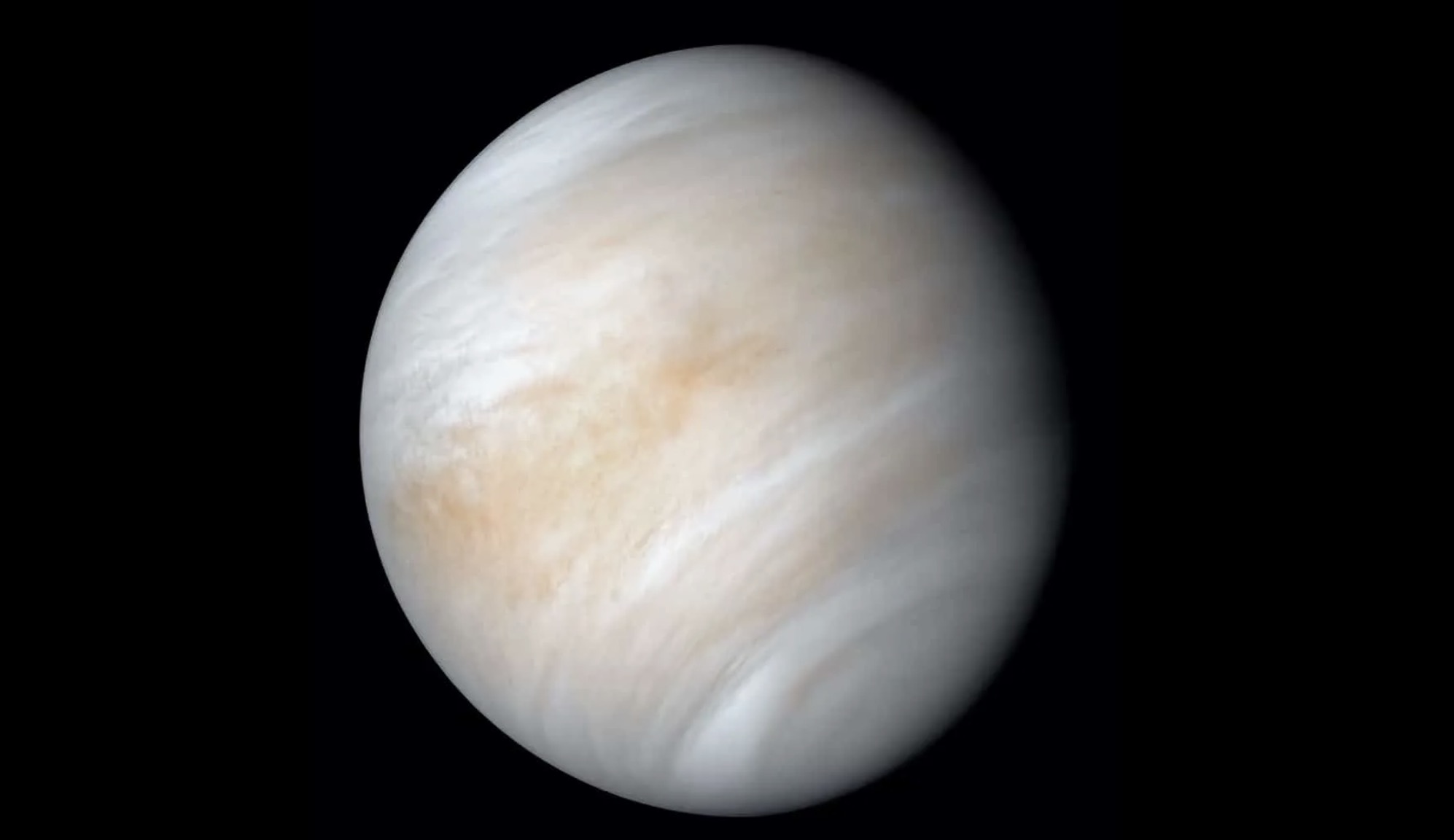
Venus formed about 4.5 billion years ago, at the same time as the other inner planets of the Solar System. It is the second planet from the Sun. The average distance is about 108.2 million km, and it is the closest neighbor of Earth.
The diameter of Venus is 12,104 km, which is about 95% of Earth’s size. It goes around the Sun in 225 Earth days (one Venusian year). But it spins extremely slowly and backward: one full rotation takes about 243 Earth days. Because of this retrograde rotation, a solar day — from one sunrise to the next — lasts about 117 Earth days. The planet’s axial tilt is about 177°, so it is almost upside down.
Venus is the hottest planet in the Solar System. Its surface temperature is about 462 °C, and it hardly changes between day and night, unlike on Mercury. This happens because of a very dense atmosphere, made of about 96.5% carbon dioxide with clouds of sulfuric acid. The strong greenhouse effect keeps the temperature stable and extremely high. The surface pressure is about 92 bar — almost 100 times higher than on Earth.
Venus has no moons or rings. It has only a very weak magnetic field, probably generated by interaction between the solar wind and its atmosphere. Its surface is rough, with highlands, plains, and thousands of volcanoes. Because of the thick clouds, the ground cannot be seen from space, but radar mapping shows mountains, valleys, and lava flows.
With its crushing pressure, acidic clouds, and extreme heat, the surface is deadly for life as we know it. However, some scientists think that high in the clouds, where the temperature and pressure are milder, tiny forms of life might possibly exist. For now, Venus remains one of the most mysterious planets in our Solar System.
LISTEN TO THE TEXT

За полгода вывожу ученика начального уровня на уровень уверенного общения, свободного выражения своих мыслей. Специализируюсь на экспресс-методах обучения.
