


/…/
—
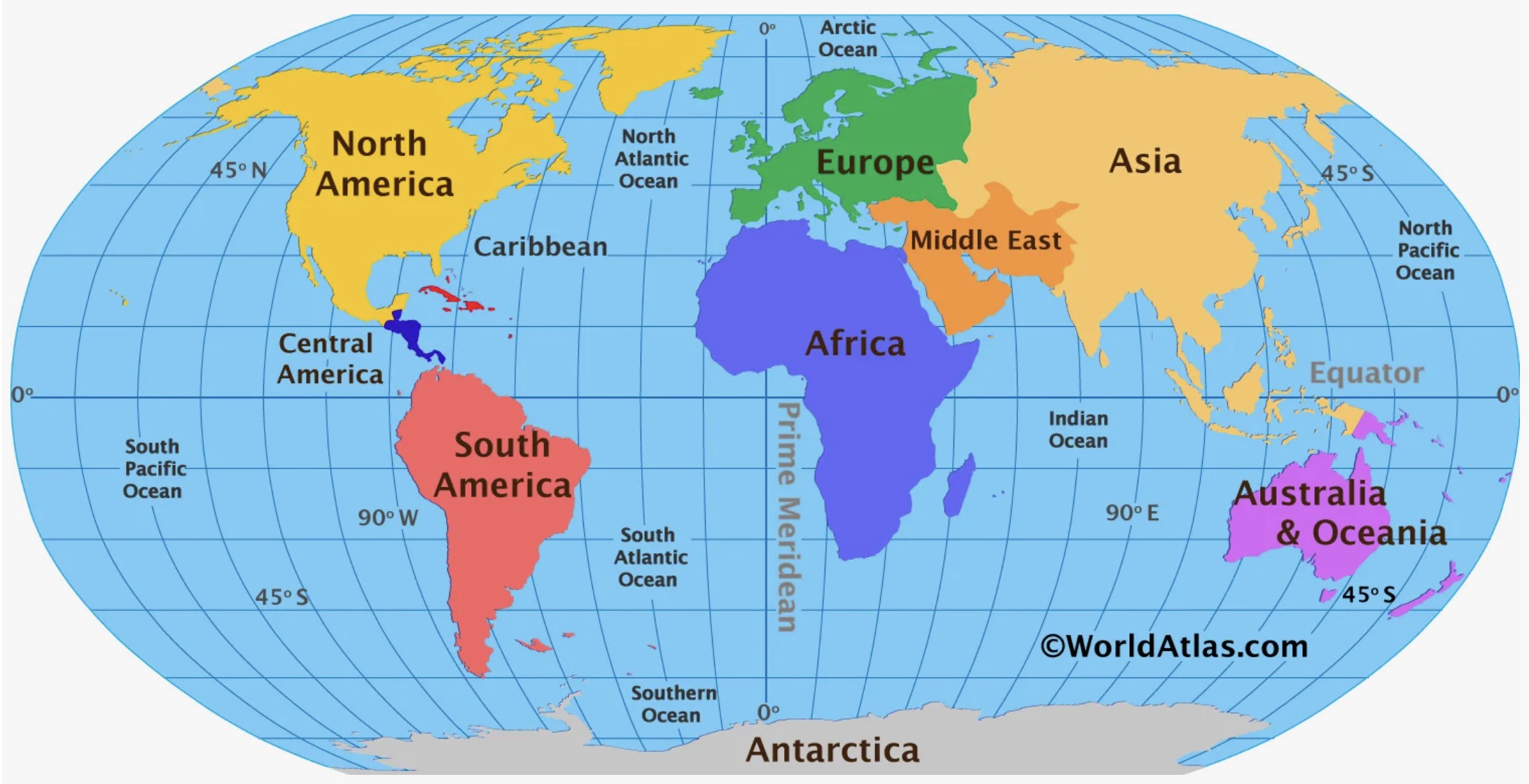
The continents are the largest landmasses on Earth, forming the main divisions of our planet’s surface. Traditionally, there are seven continents: Africa, Antarctica, Asia, Europe, North America, South America, and Australia. Each continent has its own unique geography, cultures, and history, making them key topics for learning about the world.
Long, long ago, all the land on Earth was one big piece. It was called Pangaea. Over a very long time, Pangaea slowly broke into pieces. These pieces became the continents.
The continents do not stay still. They move very slowly on the Earth. They move only a few centimeters each year. In one million years, a continent can move many kilometers. This movement is very slow, but it never stops.
Today, there are seven continents on Earth. They are Africa, Asia, Europe, North America, South America, Australia, and Antarctica.
The largest continent is Asia. It has many people, mountains, and rivers. Africa is called the cradle of civilization because the first people lived there. Europe became important for science and philosophy.
The Americas were home to ancient civilizations like the Maya, Aztec, and Inca. South America has the Amazon rainforest, which is often called the lungs of the Earth.
Australia is special because it is both a continent and a country. Antarctica is covered with ice. No people live there forever, but scientists work there.
All continents together cover about 29% of the Earth’s surface. The rest of the Earth is water.
LISTEN TO THE TEXT

За полгода вывожу ученика начального уровня на уровень уверенного общения, свободного выражения своих мыслей. Специализируюсь на экспресс-методах обучения.