
К содержимому

logo_1.jpg


CATBRIDGE-SCIENCE-STUDYING

This page gathers various educational materials on science — for practice, review, and in-depth learning. Use flashcards, tests, and tasks to train, check yourself, and master the school program with interest and benefit.

CATBRIDGE — SCIENCE STUDYING MATERIALS

The Solar System

  • • General overview: what the Solar System includes.
    • The Sun, planets, moons, asteroids, comets.
    • The concept of orbit.


The Sun


Mercury


Venus

  • • Venus — the “sister of Earth,” its atmosphere and high temperature.


Earth and the Moon

  • • Features of Earth: atmosphere, water, life.
    • The Moon as a satellite: phases of the Moon, tides.


Mars

  • • The Red Planet: climate, surface, exploration .
    • Possibility of life.


Jupiter

  • • The largest planet.
    • Atmosphere, the Great Red Spot.
    • Galilean moons (Io, Europa, Ganymede, Callisto).


Saturn

  • • Famous rings.
    • Structure of the planet and its moons (e.g., Titan).


Uranus


Neptune


Minor Bodies of the Solar System

  • • Asteroids, meteors, meteorites.
    • The asteroid belt, the Kuiper belt.
    • Comets and their tails.


The Solar System and Beyond

  • • The concept of “dwarf planets” (Pluto and others).
    • Comparison of the Solar System with other star systems.
    • Exoplanets.

NATURAL PROCESSES

  • • Here you can explore a variety of physical and chemical processes found in nature.


SCIENCE-SOLAR SYSTEM

Why does it rain?

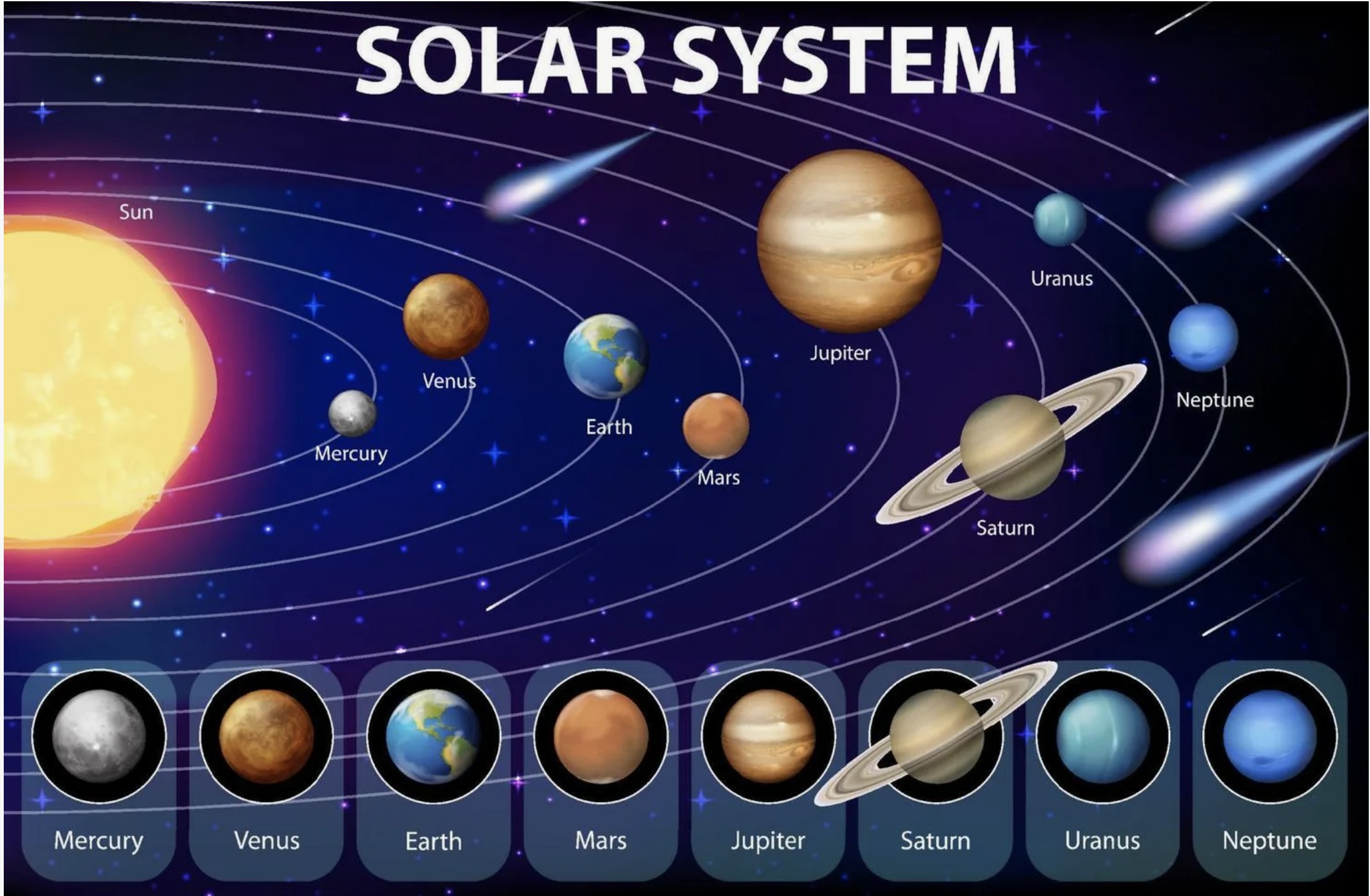
The Solar System has the Sun in the center. It has eight planets and many moons. There are also dwarf planets, asteroids, and comets.

SOLAR SYSTEM

solar system
Picture of Solar System.

The Solar System began about 4.6 billion years ago, forming from a large cloud of gas and dust. Our Solar System is part of the Milky Way galaxy, which contains hundreds of billions of stars.

At the center of the Solar System is the Sun. Its gravity holds everything in orbit. All objects in the Solar System go around the Sun because it is the most massive body, containing about 99.8% of the system’s total mass. In other words, if you combine the masses of all the planets, moons, asteroids, and meteoroids, they will have less than 1% of the Sun’s mass.

There are eight planets: Mercury, Venus, Earth, Mars, Jupiter, Saturn, Uranus, and Neptune. The first four are rocky, Earth-like (terrestrial) planets. The next two are giant gas planets (Jupiter and Saturn), and the last two are ice giant planets (Uranus and Neptune).

Beyond Neptune is the Kuiper Belt, which contains dwarf planets such as Pluto, Eris, Haumea, and Makemake, along with many comets and other small icy bodies.

Our entire Solar System goes around the center of the Milky Way at about 220 km/s (≈ 790,000 km/h). It takes roughly 230 million years to complete one lap. The Milky Way itself is also moving through space at about 600 km/s (≈ 2.2 million km/h).


LISTEN TO THE TEXT


Untitled2