

/…/
—
Animal Cell works as a coordinated system: the cell membrane controls transport in and out, the nucleus stores DNA, RNA carries instructions, ribosomes build proteins, mitochondria generate energy, and other organelles handle processing, packaging, and recycling.
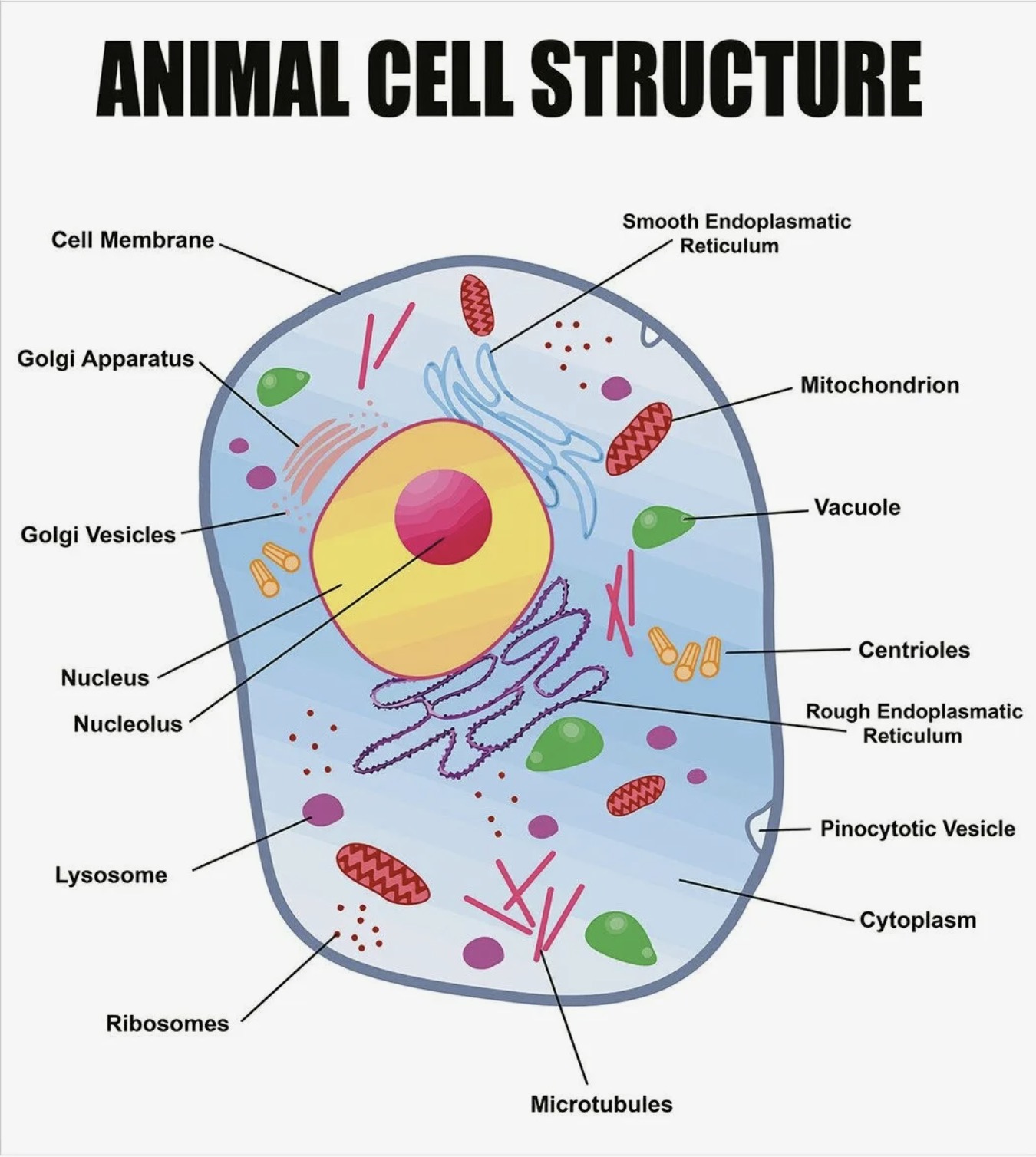
Animal cell basics. The human body consists of trillions of cells. Our body has many different types of cells, each with its own function. Here is how a typical animal (or human) cell works: it has a cell membrane – a thin layer that protects the cell and controls what enters and leaves it, cytoplasm – a jelly-like fluid that fills the cell and surrounds all the organelles, a nucleus with DNA – it stores all the genetic information and controls the cell’s activities, ribosomes – protein “factories”, mitochondria – the cell’s “power plants”, the Golgi apparatus – “warehouses and post offices” that modify and package molecules, lysosomes – “cleaners” that clean the waste, and the cytoskeleton – a network of protein fibres that helps the cell keep its shape and move.
Nutrient delivery. Cells are surrounded by intercellular fluid, which is supplied by blood vessels. Capillaries bring nutrients and oxygen. Many cells divide, allowing tissues to renew themselves.
Cell membrane. Every cell has a membrane that encloses organelles — the internal structures that perform different tasks. The membrane protects the cell and regulates what enters and leaves.
Nucleus & Nucleolus. The nucleus is the cell’s main control center. It stores DNA — a long molecule containing genes. Genes are instructions for the cell’s work and reproduction.
Inside the nucleolus, rRNA is synthesized. Ribosomal subunits (small and large “blanks”) are assembled from rRNA and ribosomal proteins.
Ribosome assembly. These subunits exit into the cytoplasm, where they mature. When they “dock” onto mRNA, which is synthesized in the nucleus and then go to sytoplasm too. The small and large subunits combine to form or synthesize a working ribosome.
Ribosomes. Ribosomes are the cell’s “protein factories.” They build proteins from amino acids according to the instructions on mRNA. Amino acids come from food, and some of them are synthesized with the help of gut bacteria. Blood delivers all of this to the cells.
So we eat proteins, they break down into amino acids, and the cells use these amino acids to synthesize their own proteins, which serve as building material and perform important functions in the body.
Cytoskeleton. To maintain internal order, the cell uses internal membranes and the cytoskeleton — a support framework made of microtubules and filaments. It maintains shape, enables movement, and positions organelles correctly.
Mitochondria. Mitochondria are the cell’s “power plants”: they generate energy (ATP) through cellular respiration.
Lysosomes. Lysosomes are recycling centers: their enzymes break down waste, damaged parts, and foreign microorganisms, keeping the cell clean.
Golgi apparatus. The Golgi apparatus is the cell’s “warehouse and post office”: it packages and sorts proteins, lipids, and waste into vesicles for transport within the cell or outside it.
LISTEN TO THE TEXT

За полгода вывожу ученика начального уровня на уровень уверенного общения, свободного выражения своих мыслей. Специализируюсь на экспресс-методах обучения.
